-
Electric Vehicle Council research finds the upfront costs of EVs can sometimes be more expensive than petrol/diesel vehicles; however, the charging and maintenance of an EV is much cheaper so lifetime costs are more favourable. Plus, many Australian Governments also offer incentives to help to reduce the upfront cost of an EV.
The higher upfront cost of some EVs is primarily due to the cost of batteries. As battery costs continue to fall (currently about 20% year on year), EVs continue to become cheaper.
Just a few years ago most EVs cost more than $100,000, and now there are several models available in Australia for under $40,000.
On average, EV owners can expect to save about $10,000 over five years of ownership when comparing an electric SUV with a petrol SUV.
It’s also important when comparing EVs with other vehicles that they are like-for-like, meaning they include the same level of safety, technology, and other features.
See a full list of EVs available in Australia here.
-
According to fleet technology provider Geotab’s analysis of 10,000 EVs the average degradation of EV batteries is 1.8% per year, which indicates batteries should last 20 years or more before reaching the commonly used end-of-life threshold of 80% efficiency.
Another, peer-reviewed study found that battery electric vehicles (BEVs) are showing an average lifespan of 18.4 years, which is comparable to internal-combustion-engine cars.
Real-world usage data suggests many batteries still retain over 80% capacity after the odometer passes 200,000km.
-
It’s significantly cheaper to ‘refuel’ a car battery than a petrol engine, and the overall difference because greater with every year of car ownership.
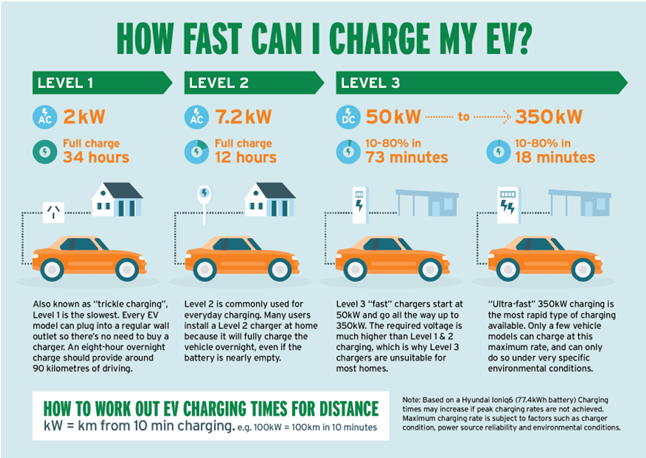
Estimates by the Australian Renewable Energy Agency (ARENA) are that, in NSW, charging at home costs about $3.60 per 100km for a typical EV (using 14.4 kWh/100 km and $0.25/kWh electricity) and can take 12-34 hours to achieve a full charge.
This is variable based on if the house has solar and battery systems installed, energy provider pricing, and the timing of charging. Most EV charging happens at home (80% of Australian drivers plug in there) because it’s most convenient, and it’s also where the cheapest energy is if charging during off-peak periods or using excess solar production.
Public charging costs more than home charging: between $5 and $10 per 100km depending on charger, battery size, etc. Charging rates for an 80% charge vary between 73 minutes (standard public charger) to 18 minutes (superchargers). Usually, the faster the charge, the higher the cost.
By comparison, a standard SUV costs on average $16 and 20 per 100km; so, the savings with EVs are significant.
Quick cost comparison (November 2025)
• EV at home: approx $4–5 / 100 km
• EV at public fast charger: approx $5–10 / 100 km
• Petrol cars: approx $12–25 / 100 km
Even using public chargers, EVs cost 30–60% less per km to “fuel” -
Charging an EV at home is essentially like plugging in a giant smartphone. You have two main options:
Standard Wall Outlet: Plug the portable charger that came with your car into a regular 10-amp wall socket. It adds about 10–15 km of range per hour—perfect for overnight top-ups.
Dedicated Wall Charger: It charges 3–5 times faster, adding 40–70 km of range per hour, and often includes smart scheduling and solar-charging features.
To do this you require:
- A trained and qualified electrician to install the charger, connect it to your home switchboard, set up the circuit breaker, ensure RCD/RCBO protection, and appropriate wiring, etc. to as well as certification post-job.
- Appropriate electrical supply and wiring capacity in your home (single-phase vs three phase, distance from switchboard to charger location, possibly upgrading switchboard or cabling) that meets Australian electrical standards (e.g. AS/NZS 3000).
- A suitable location: either a garage or driveway with off-street parking and safe weather protected mounting if outside; also, the correct plug-type (Type 2/Mennekes in Australia) and cables.
- (Optional) Smart features / solar integration / app control if you want to optimise charging (e.g., charge when electricity is cheapest or when solar power is available).
Prices vary for equipment and installer; however (in 2025) combining hardware and installation, Australian homeowners typically pay between $1,500 to $3,000 to install a home charger.
-
The NSW Government has invested $199 million to support private charger point operators to install chargers at various locations across the state, including carparks, along major highways, and at accommodation such as hotels and residential areas.
A handy FAQ sheet (PDF) on the NSW government’s EV Charging Program can be downloaded using the link below, or check out the map above to find chargers for your next trip: NSW Government Electric Vehicle Charging Program Q&As
Our map on our front page provides you with locations across NSW
-
According to the Electric Vehicle Council of Australia 2025 Market Update, in Australia, the average EV range for new models is around 450 km per full charge (real-world WLTP* figures). Entry-level EVs such as the MG4 Excite 51 kWh get about 350 km, while premium models such as the Tesla Model 3 Long Range reach up to 629 km (WLTP).
Long-range models such as the Hyundai Ioniq 6 Dynamiq can go around 614 km, and the BYD Seal Premium about 570 km.
* WLTP (Worldwide Harmonised Light Vehicle Test Procedure) figures are standardized measurements for a new vehicle’s fuel economy, CO2 emissions, and electric driving range. Developed to be more realistic than the previous NEDC test, WLTP figures are obtained from a laboratory test that simulates various driving conditions and behaviours, including different speeds, accelerations, and stoppages.
-
Both cold and hot weather affect EV range.
Lithium-ion batteries work best around 20–25°C. When it’s cold, ions inside the battery move more slowly, reducing both available capacity and charging efficiency.
In winter, people tend to have their heaters on, and this draws more power from the battery. At 0–10°C, this can lead to a range reduction of 10–25%. Using seat and steering-wheel heaters instead of full cabin heat helps preserve range.
In summer, it’s air conditioners that use more power. Tests reveal a 5–15% range reduction when driving in temperatures over 35°C.
-
Over their entire lifecycle, electric vehicles (EVs have a significantly smaller carbon footprint than petrol (internal combustion engine, or ICE) cars, even when accounting for battery production and electricity generation.
Although the manufacturing footprint is higher for EVs, with no tailpipe emissions and increasing reuse of recycled battery components, an EV represents significantly lower emissions than a petrol/ICE car over the same lifetime.
Furthermore, in Australia, the electricity grid is decarbonising. As of 2025, renewables make up about 39% of electricity generation. And, we are on target for 82% renewable energy generation by 2030. So, whether you are using solar at home, or tapping into the grid, the emissions produced by energy production are vastly lower for EVs than petrol or diesel cars.
Once they drop below 80% efficiency, car batteries are either repurposed for stationary battery purposes (e.g. at home) or recycled for components.
Modern recycling facilities can recover up to 95% of key materials like lithium, nickel, cobalt, and copper. In Australia, companies like Livium and Neometals are developing large-scale recycling solutions.
-
Yes, EVs can tow! To be able to tow, a vehicle requires torque and EV’s have instant torque. The towing capacity of electric vehicles will vary across brands and models.
Check out this link to find the towing ability of EVs available in Australia: Electric Car Advice Australia – Towing Ability
-
Both the NSW and Australian governments have incentives and related programs for EV ownership.
Currently there is a fringe benefit tax (FBT) exemption for eligible EVs and associated car expenses. Under the exemption, employers and employees can salary package EVs without incurring FBT, significantly reducing the vehicle’s overall cost. However, the vehicles must be below the luxury car tax threshold.
Under its EV strategy, the NSW Government is investing $289 million, which includes incentives for fleets and charging infrastructure.
Check-out current incentives and grants using the links below:
• NSW Government’s Electric Vehicle Strategy
• Australian Tax Office – Electric cars exemption